[Chapter 3] Harrison Lost Control of the Company He Tried to Secure Through Marriage—But Eleanor’s Real Victory Came Long After the Wedding, When She Stopped Letting Betrayal Decide What Happened Next
The legal process took years.
That frustrated everyone who wanted a dramatic ending.
Harrison did not leave our failed wedding and immediately enter prison.
Sterling Urban did not collapse overnight.
Khloe did not become poor by Tuesday morning.
Reality demanded documents.
Interviews.
Audits.
Expert analysis.
Negotiations.
Charges only where evidence supported them.
That was better.
Slower.
But better.
Harrison eventually faced federal charges related to lender representations, undisclosed related-party interests, and transaction conduct supported by the investigation.
Some allegations ended in negotiated resolution.
Some did not survive.
Khloe entered a cooperation agreement and accepted responsibility for disclosure and financial conduct tied to Ashford Strategic.
Her company was dissolved during restructuring.
She paid restitution and civil penalties calculated through the process.
I never celebrated.
That surprised people.
But watching someone else lose everything does not restore what they took from you emotionally.
It just creates another event.
Sterling Urban survived.
Under different leadership.
Independent directors.
New conflict rules.
Harrison’s family lost much of its voting control after restructuring and investor action.
Again:
Not because I seized anything.
I owned no Sterling shares.
My family office had simply refused to guarantee the debt that would have increased our exposure while unresolved conflicts existed.
Sometimes power is not taking something away.
It is declining to keep holding it up.
My mother kept the red ring box.
The one containing the ring I had intended for Harrison.
I discovered this years later.
“Why?”
I asked.
She shrugged.
“You left it in the suite.”
“You could’ve thrown it away.”
“I considered it.”
“Then?”
“I decided you should eventually choose.”
I stared.
“That sounds annoyingly wise.”
“I’m your mother.”
“It’s required.”
I opened the box for the first time nearly a year after the wedding.
Simple platinum band.
Nothing extravagant.
Inside I had engraved:
Choose me every day.
I laughed.
Then cried.
Because that was exactly what Harrison had wanted from me.
Choice.
But only if my choice remained yes.
Real choice includes no.
I sold the ring.
Donated the money to a legal-aid organization supporting women navigating financial coercion during divorce and separation.
Not because my experience was identical to theirs.
It wasn’t.
But control leaves similar fingerprints across very different lives.
For almost two years, I did not date.
Not a vow.
Not trauma theater.
I simply enjoyed decisions no longer requiring negotiation with someone who treated compromise as surrender.
Work.
Dinner.
Travel.
My apartment.
Silence.
I rediscovered that solitude and loneliness are different things.
That lesson was useful.
Then Julian Thorne entered my life.
Not at a gala.
Not in a dramatic rescue.
During a municipal redevelopment hearing.
He was an architect specializing in restoration.
Forty-one.
Divorced.
One daughter.
Annoyingly patient.
We disagreed about preserving the facade of a historic building my investment group was financing.
I thought his proposal cost too much.
He thought mine destroyed the building’s character.
Our first conversation lasted forty minutes and contained nothing romantic.
Perfect.
Months later, he asked me to dinner.
I said no.
He nodded.
“Alright.”
Then discussed zoning for twenty more minutes.
That stayed with me.
No sulking.
No argument.
No attempt to negotiate my answer into a yes.
Three weeks later, I asked him for coffee.
He smiled.
“Alright.”
I nearly laughed.
The word had changed.
Julian knew about Harrison.
Everyone did.
He never asked for details until I offered them.
When I finally told him about the ring, he said:
“That must have been awful.”
Not:
I would never do that to you.
Not:
He was a fool.
Not:
You’re better off.
Just recognition.
Again:
Useful.
We dated for three years.
Slow.
He met my mother.
I met his daughter, Sophie.
No one was forced into instant family.
Sophie disliked me for six months.
Reasonable.
I was a new adult occupying her father’s attention.
So I did not try to buy her love.
We developed our own relationship over time.
Mostly by mocking Julian’s inability to cook rice.
When Julian proposed, it happened at home.
No audience.
No photographers.
One ring.
Chosen for me.
He asked:
“Would you like to marry me?”
Not:
Will you?
I noticed the wording.
“Would you like to…”
Choice centered even in the question.
“Yes.”
Then:
“But I’m reviewing the prenup.”
He laughed.
“I would be offended if you didn’t.”
Good answer.
We married in a small ceremony.
My mother wore navy again.
She claimed it was coincidence.
I did not believe her.
No chandeliers.
No 120 tables.
No public spectacle.
Sophie stood beside Julian.
Beatrice Lawson attended and threatened to bill me if anyone mentioned Plan B during dinner.
Nobody did.
Mostly.
Khloe sent a letter before the wedding.
We had not spoken in years.
I almost returned it unopened.
Then read it.
She wrote:
I spent a long time telling myself Harrison manipulated me, because that made it easier not to look at what I chose.
Good beginning.
He did manipulate me. I also accepted your ring. I stayed on that stage. I benefited from secrecy. Both are true.
I sat with that.
Then:
I am sorry. I do not expect forgiveness or an answer.
I never answered.
Not from cruelty.
The letter did not require one.
An apology should not create another obligation for the injured person.
Harrison wrote too.
Years earlier.
His letter was different.
He apologized for the wedding.
For the business pressure.
For trying to turn marriage into a structure where my independence had to shrink so he could feel secure.
He wrote:
When you said “All right,” I thought you were giving up. It took me years to understand you had simply stopped negotiating against yourself.
That line I kept.
The rest I eventually destroyed.
My mother asked me once:
“Do you regret the seven years?”
I thought about it.
“No.”
She seemed surprised.
“Why?”
“Because regretting Harrison would require regretting the woman I was while loving him.”
“I don’t.”
“She missed things.”
“She tolerated things too long.”
“But she was sincere.”
Then:
“I won’t punish her because he wasn’t.”
That answer took me years to earn.
People still tell the wedding story incorrectly.
They say Harrison gave his mistress my wedding ring and I calmly destroyed his $900 million company before dessert.
No.
Khloe’s exact relationship with him was complicated.
The company survived.
I did not destroy it.
I did not freeze Harrison’s personal accounts.
I did not command banks.
I did not call the FBI from my bridal suite and order arrests.
Plan B did something much less cinematic.
It removed my family’s voluntary support from transactions I no longer trusted.
Preserved documents.
Alerted independent directors.
Created a record showing my concerns existed before the wedding humiliation.
Then facts did whatever facts were going to do.
That matters.
Because revenge depends on the injured person remaining powerful forever.
Evidence does not.
The most famous moment remains:
“All right.”
People hear it and imagine I felt nothing.
Wrong.
I felt everything.
Seven years disappearing.
The wedding I had imagined.
The humiliation of seeing a ring I chose sitting perfectly on someone else’s hand.
My mother’s fingers around my wrist.
Hundreds of eyes.
What changed was not pain.
It was bargaining.
I stopped bargaining.
Stopped asking:
What can I tolerate to keep this relationship?
What can I surrender to prove I love him?
What can I ignore so the wedding still happens?
The answer became:
Nothing else.
That was all “All right” meant.
Not:
You win.
Not:
I forgive you.
Not:
I don’t care.
It meant:
I finally understand the choice you’re offering me.
And I decline.
Years later, Julian and I attended another wedding at the same Fifth Avenue hotel.
Different ballroom.
Different couple.
I thought I would feel something dramatic.
I didn’t.
We passed the corridor leading toward the old bridal suites.
Julian asked:
“You okay?”
“Yes.”
Then I surprised myself.
“I want to see something.”
We walked toward the hallway.
The exact suite had been renovated.
Different door.
Different carpet.
No red envelope.
No veil.
Nothing remained.
Good.
Places should not be forced to preserve our pain just because we remember it.
Julian took my hand.
Not tightly.
Just enough.
“Ready?”
I looked at him.
“All right.”
This time I smiled.
My name is Eleanor Mercer.
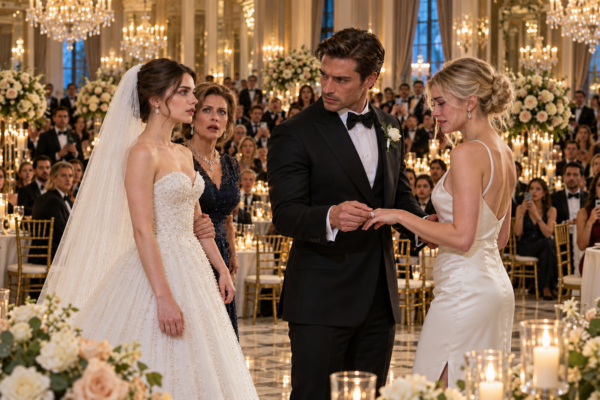
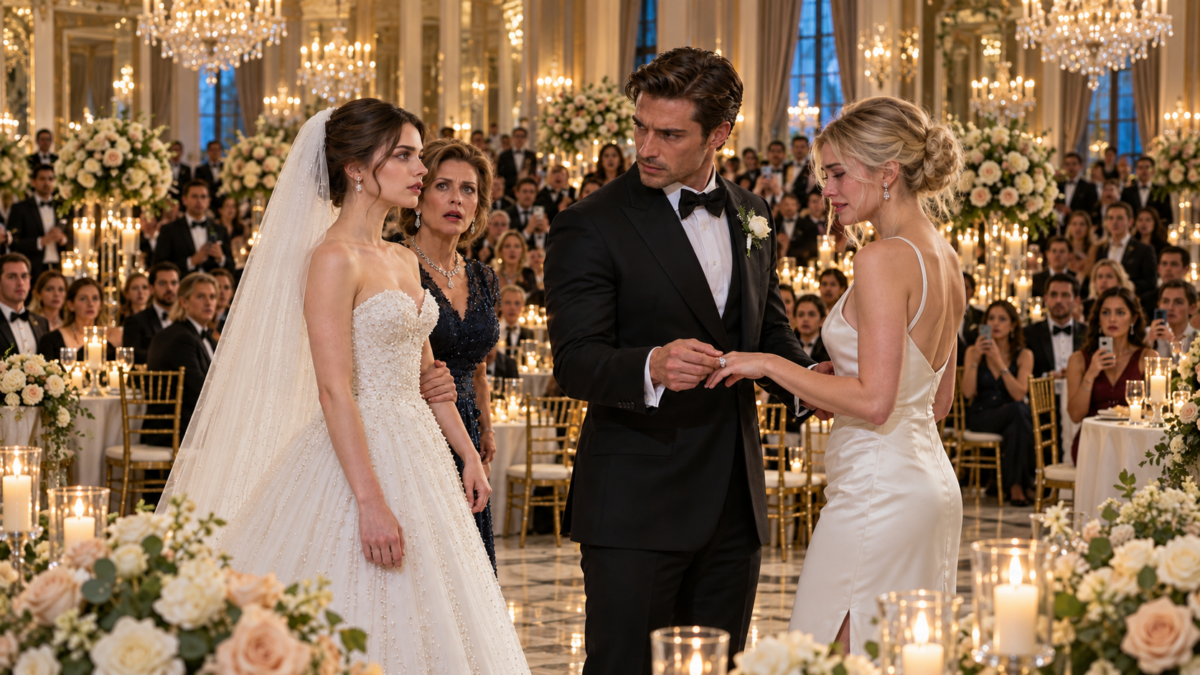
At twenty-nine, I stood beneath crystal chandeliers while the man I had loved for seven years put my wedding ring on another woman.
He told me:
“If you refuse to be submissive, I’ll make Khloe my wife.”
He expected me to break.
Instead I said:
“All right.”
Then I walked away.
That sentence became the most powerful thing I ever said because it contained no threat.
No revenge.
No explanation.
Just acceptance of a truth I had spent too long trying to negotiate away.
Harrison did not want a wife who chose him.
He wanted a wife whose ability to choose had boundaries.
I could never become that woman without disappearing inside the marriage.
So I left while I was still fully myself.
Plan B protected the company.
Lawyers protected the record.
Boards protected shareholders.
Courts handled whatever evidence eventually justified.
But none of those things made the first decision for me.
That belonged to one bride standing at the altar without a ring.
And if I could speak to her now, I would not tell her:
Don’t cry.
She deserved to cry.
I would not tell her:
You’ll find someone better.
That wasn’t the point.
I would tell her something simpler.
When somebody offers you love on the condition that you become smaller—
believe the condition.
Then choose accordingly.
Sometimes freedom does not begin with a speech.
Sometimes it begins with two quiet words spoken in a room waiting for you to beg.
All right.
And then—
you walk.